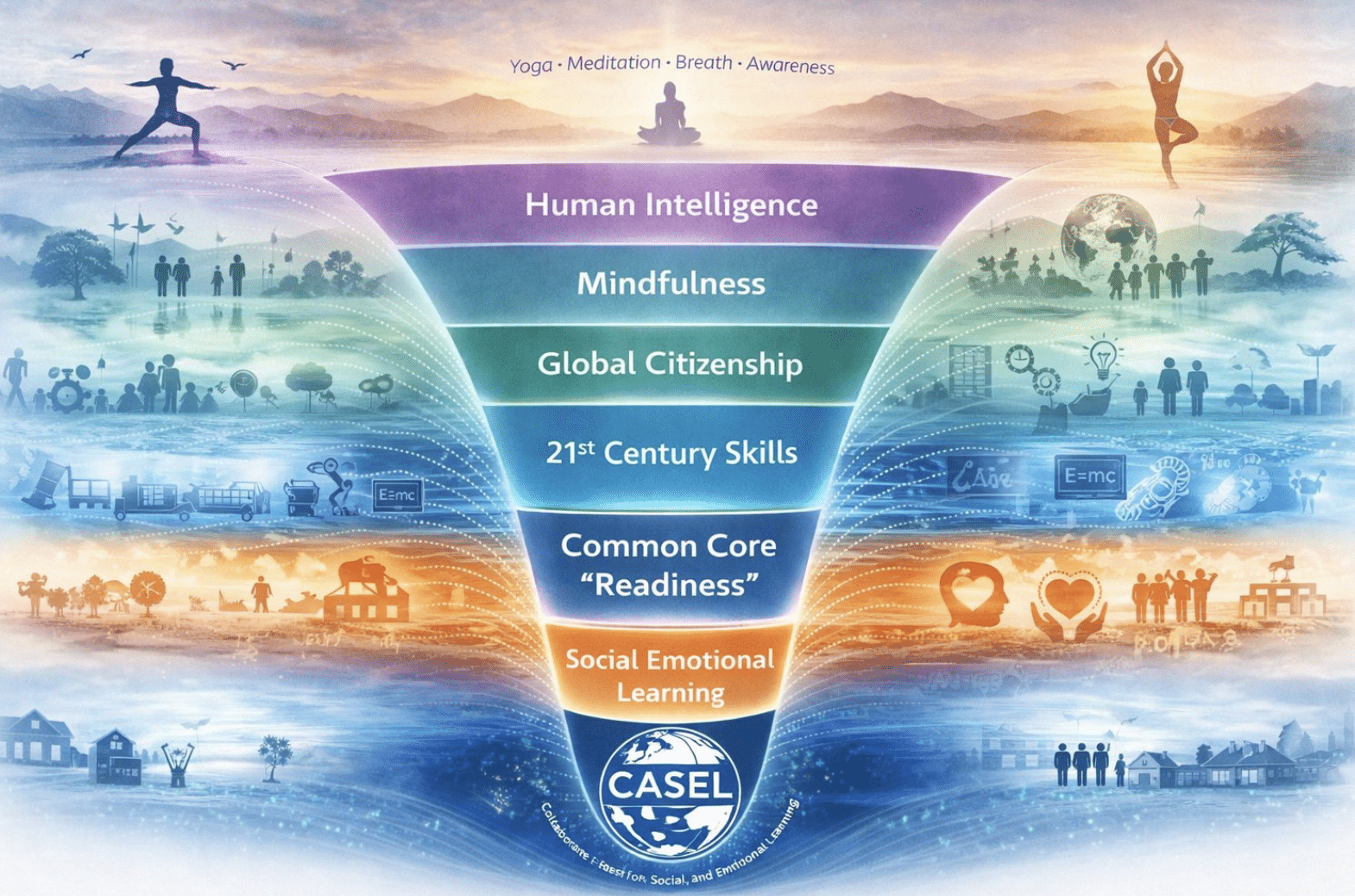
Reach Capital manages billions. It helped build the edtech infrastructure that reshaped American K-12 education — seeded by veterans of NewSchools Venture Fund, Teach For America networks, and Silicon Valley. Now one of its portfolio companies is selling schools something it calls “Human Intelligence.”
The pitch is disarming. Warm. Relational. Student-centered. A necessary complement to the cold automation creeping into classrooms. But Government Accountability Institute researcher Priscilla West says follow the framework past the branding and you find something else: an expanding architecture for assessing, scoring, and storing the inner lives of children.
No new legislation required. No public debate. Just existing federal dollars — ESSA grants, Title IV well-being funds — quietly redirected toward a framework that doesn’t stop at emotions. It reaches into students’ bodies, their relationships, their sense of purpose and meaning. Five layers of “intelligence,” all of them now formally trackable.
Five Layers. Deeper Than SEL.
The Human Intelligence Framework™ breaks student development into five domains: Cognitive (thinking), Emotional (feelings), Social (relationships), Somatic (body and physical awareness), and Universal — described as purpose, meaning, and connection to something larger than oneself.
For context: traditional Social-Emotional Learning focused on emotional regulation and interpersonal skills. This goes further — into the body and into questions of meaning that touch the domains of philosophy and faith.
It synthesizes earlier iterations — Emotional Intelligence, mindfulness, trauma-informed practices — into what Breathe for Change calls “one coherent approach for the modern world,” activating the “full spectrum of human intelligence.” Different language. Expanded scope. Same student profiling.
How It Gets Into Classrooms — No Mandate Needed
Parents might assume something this expansive requires new legislation or a budget fight. It doesn’t.
Districts can use existing federal dollars — ESSA grants, Title IV funds earmarked for student well-being or teacher training — to adopt programs like this without a single vote or public debate. That’s the runway programs like Breathe for Change travel to reach students. Quietly. Through the back door of existing funding streams.
The Pattern
West charts the evolution: Emotional Intelligence → SEL → 21st Century Skills → life skills → mindfulness → Human Intelligence.
The labels change. The direction doesn’t. Each iteration formalizes a broader slice of students’ inner lives — emotions, relationships, bodies, values — into structured frameworks designed to be assessed, scored, tracked, and stored.
The destination, West warns, is something more consequential than a wellness curriculum. It’s psychological, social, and moral formation — operating at scale, inside existing systems, with the lights off.
1/
As the school year winds down, “Human Intelligence” is being promoted alongside AI in Education.Framed as a necessary complement, it deserves a closer look.
It expands SEL into new domains — emotional, social, somatic, even “purpose” and meaning.
Different language.… pic.twitter.com/XrrxRo6auf
— Priscilla West (@PriscillaWest77) March 31, 2026
